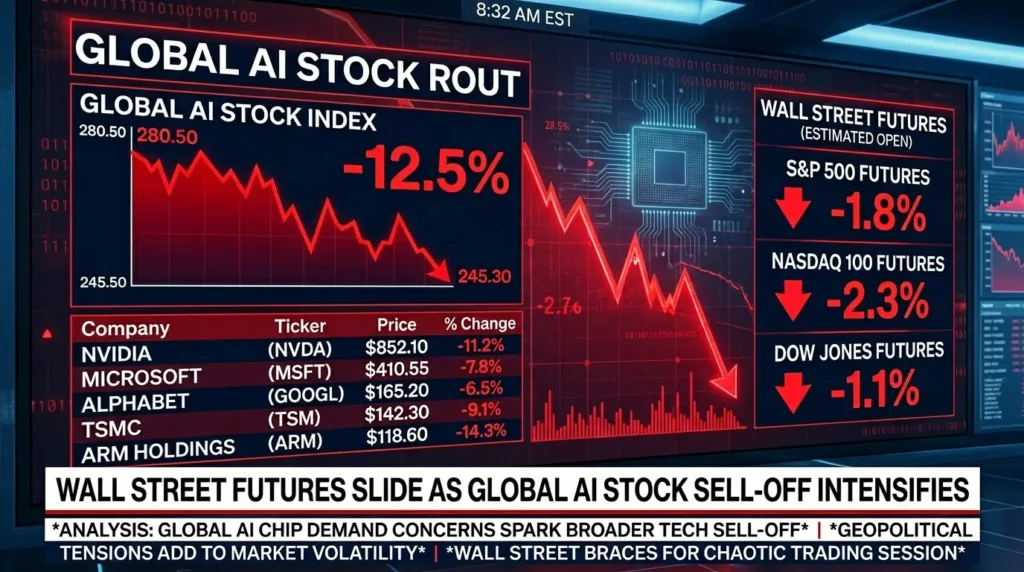
US stock futures fell sharply on Tuesday, pointing to a difficult opening for Wall Street after a wave of selling in technology stocks spread from Asia to the United States. Investors grew increasingly concerned that the rapid rise in AI-related stocks may have pushed valuations too high, triggering a broad market pullback.
Nasdaq and S&P 500 Futures Decline
Before the opening bell, Nasdaq 100 futures dropped around 2.5%, while S&P 500 futures lost approximately 1.3%. Dow Jones Industrial Average futures showed greater resilience but were still down roughly 0.6%.
The weakness followed Monday’s trading session, during which technology giants led US markets lower. The Nasdaq Composite recorded another decline as investors reduced exposure to high-growth AI companies after months of strong gains.
South Korea’s KOSPI Sparks Global Sell-Off
The latest market decline gained momentum after South Korea’s KOSPI index plunged nearly 10%, forcing a temporary trading halt. Heavy losses in semiconductor leaders SK Hynix and Samsung Electronics fueled fears across the global technology sector.
Reports suggested that SK Hynix may slow the expansion of its AI memory chip production while shifting greater focus toward traditional DRAM products. The news prompted investors to reassess expectations for AI infrastructure spending, leading to widespread selling in AI-related semiconductor stocks.
Technology shares across Asia also came under pressure, ending an extended rally as investors locked in profits.
Investors Question the AI Investment Boom
The AI sector has been one of the strongest drivers of global stock markets throughout 2026. Massive investments in data centers, AI chips, and cloud infrastructure pushed technology companies to record valuations.
However, recent market volatility reflects growing concerns about whether companies can generate enough long-term revenue to justify those high valuations. Investors are becoming more cautious as AI-related stocks continue to trade at premium prices.
Focus Shifts to Micron Earnings
Market participants are now closely watching Micron Technology’s upcoming quarterly earnings report. Analysts believe the results will offer valuable insight into demand for AI memory chips and provide clues about future spending on AI infrastructure.
Strong earnings could help restore confidence in the sector, while disappointing guidance may trigger additional selling across semiconductor and AI stocks.
Signs of Overheated Valuations
Many investors also point to excessive market optimism in recent months. Shares of SK Hynix had surged by nearly 350% earlier this year before experiencing Tuesday’s sharp decline. At the same time, margin borrowing among South Korean retail investors reached record highs, indicating increased speculative trading activity.
These factors have raised concerns that parts of the AI market may have become overheated.
Oil Prices Ease Despite Market Volatility
While technology stocks faced heavy selling, energy markets remained relatively stable. Oil prices moved lower after reports indicated that the United States had granted Iran a temporary 60-day license to continue international oil exports as diplomatic negotiations continued.
Brent crude traded below $77 per barrel, easing inflation concerns despite broader market uncertainty.
European and Emerging Markets Also Weaken
The technology sell-off extended into Europe, with the Stoxx Europe 600 Index falling nearly 1% during early trading. Semiconductor companies were among the biggest losers as investors reduced exposure to growth-focused technology stocks.
Emerging markets also experienced broad declines, with the MSCI Emerging Markets Index falling sharply as global investors shifted toward safer assets amid rising uncertainty surrounding AI-related investments.
Outlook
Although AI remains one of the most important long-term investment themes, recent market action highlights growing caution among investors. Upcoming earnings from major semiconductor companies and AI infrastructure providers will likely determine whether the sector regains momentum or experiences a deeper correction in the weeks ahead.