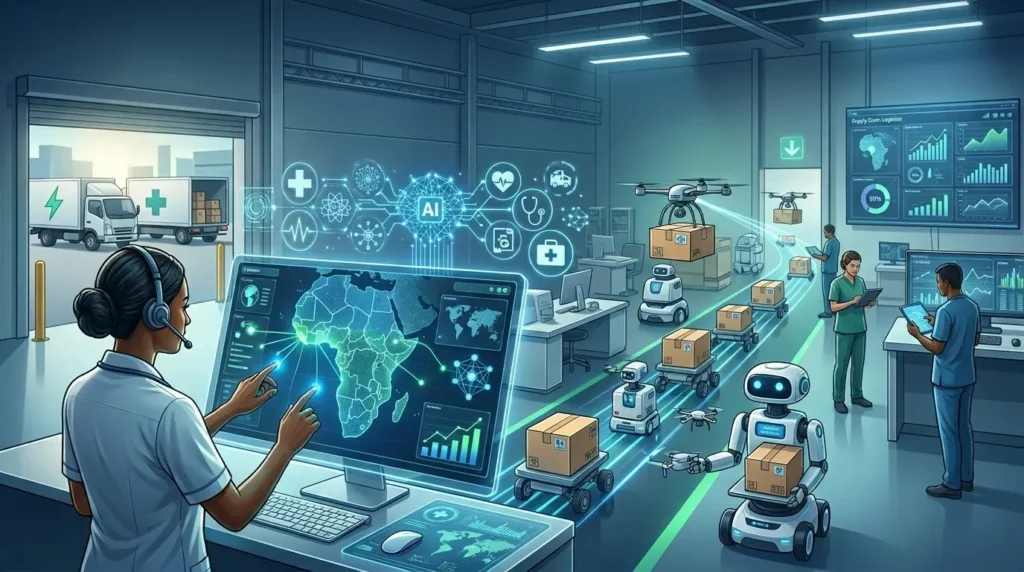
How Low-Cost AI Is Transforming Healthcare Logistics in Sierra Leone
A team of researchers has developed an affordable artificial intelligence (AI) system that is transforming healthcare logistics in Sierra Leone by helping hospitals and clinics receive the right medical supplies at the right time. The AI-powered platform is already improving access to essential medicines while operating at a cost of only $30 per month, demonstrating how low-cost technology can strengthen healthcare systems in resource-limited countries.
Tackling a Critical Healthcare Challenge
Sierra Leone continues to face one of the world’s highest maternal mortality rates, with hundreds of mothers dying for every 100,000 live births. While the government provides free healthcare for pregnant women and children under five, many clinics still experience shortages of essential medicines because supplies are not distributed efficiently.
Some health facilities receive more stock than they need, while others frequently run out of life-saving medications.
To solve this challenge, researchers from the Wharton School at the University of Pennsylvania collaborated with Sierra Leone’s government to develop an AI-driven decision-support system that predicts demand for medical supplies and recommends the most efficient distribution strategy.
AI Forecasts Medical Supply Demand
The new platform uses machine learning to estimate how much medicine each healthcare facility will need based on historical records, seasonal demand, population data, and geographic information.
Unlike traditional forecasting systems, the AI was specifically designed for environments where healthcare data is often incomplete, inconsistent, or missing altogether.
By analyzing available information, the system helps officials allocate limited medical supplies more accurately across the country’s healthcare network.
Significant Improvements in Medicine Access
Following pilot deployments across five districts, the AI system produced impressive results.
Researchers observed a 19% increase in the use of allocated medical products, indicating improved availability of essential medicines for patients.
Healthcare facilities serving remote and underserved communities experienced even greater benefits. Clinics that previously struggled with frequent stock shortages recorded a 32% increase in medicine availability after adopting the AI-powered allocation system.
These outcomes encouraged Sierra Leone’s government to expand the technology nationwide.
Supporting Millions of Patients
Today, the AI platform manages the distribution of more than 70 essential healthcare products, including:
- Medicines for postpartum hemorrhage
- Treatments for eclampsia-related seizures
- Tetanus vaccines
- Antimalarial medicines
- Medical gloves
- Other critical healthcare supplies
The system now supports healthcare logistics for an estimated two million women and children under five across Sierra Leone.
One of its biggest advantages is affordability. The cloud-based platform costs approximately $30 per month to operate and does not require additional staff, making it highly sustainable for public health systems with limited budgets.
AI Designed to Support, Not Replace, Healthcare Workers
The research team recognized that successful AI adoption required collaboration with local healthcare officials.
Rather than replacing human decision-makers, the system was designed as a decision-support tool that provides recommendations while allowing government officials to make the final allocation decisions.
Researchers also conducted extensive on-site training in Sierra Leone, building trust among local staff and ensuring the software matched existing workflows instead of introducing complicated new processes.
This human-centered approach helped encourage widespread adoption across the country’s healthcare agencies.
Machine Learning Built for Limited Data
One of the biggest technical challenges involved working with incomplete healthcare records from rural clinics.
To overcome this issue, the researchers developed a machine learning model capable of identifying patterns from multiple data sources simultaneously. The AI combines historical healthcare data with census information, travel-time estimates, and satellite imagery to predict local healthcare demand more accurately.
Even where reporting is limited, the system generates reliable baseline forecasts that improve medicine distribution across underserved regions.
Expanding AI Healthcare Solutions
Following the success in Sierra Leone, the research team is working with healthcare officials in Somaliland to adapt the same AI-powered logistics model for additional healthcare systems.
The project demonstrates that affordable artificial intelligence can significantly improve healthcare delivery without requiring expensive infrastructure or large technical teams.
As governments worldwide search for cost-effective ways to strengthen healthcare services, Sierra Leone’s AI logistics platform offers a practical blueprint for using machine learning to improve public health outcomes in developing regions.