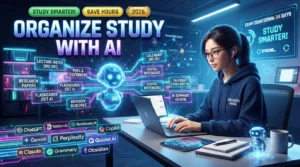
Flashcards are one of the most effective study tools for improving memory, reinforcing key concepts, and preparing for exams. They support active recall and spaced repetition—two evidence-based learning techniques that help students retain information more effectively.
Creating flashcards manually, however, can be time-consuming. Artificial Intelligence (AI) makes the process much faster by generating question-and-answer cards from textbooks, lecture notes, PDFs, and research papers within minutes.
In this guide, you’ll learn how to create flashcards using AI, discover the best AI flashcard tools, explore prompt examples, and follow best practices to maximize your learning.
Why Use AI to Create Flashcards?
AI simplifies the process of transforming large amounts of information into easy-to-review flashcards.
Benefits include:
- Saves time
- Automatically extracts key concepts
- Creates question-and-answer cards
- Supports active recall
- Works with multiple subjects
- Organizes study materials
- Helps with revision
- Improves learning efficiency
AI allows students to focus more on studying and less on formatting study resources.
What Is an AI Flashcard Generator?
An AI flashcard generator uses natural language processing (NLP) to analyze educational content and convert it into structured flashcards.
AI can generate flashcards from:
- Textbooks
- Lecture notes
- PDF documents
- Research papers
- Articles
- Class presentations
- Video transcripts
- Study guides
Many platforms also integrate spaced repetition algorithms to schedule review sessions automatically.
Best AI Tools for Creating Flashcards
ChatGPT
Excellent for generating customized flashcards, simplifying concepts, and creating question-and-answer sets.
Quizlet AI
Automatically converts notes into digital flashcards with interactive learning modes.
Anki (with AI add-ons)
Supports spaced repetition and can be enhanced with AI-assisted card generation.
Notion AI
Helps summarize notes and organize flashcards within your study workspace.
Google Gemini
Useful for generating explanations and educational flashcards.
Claude
Works well with lengthy documents and structured educational content.
Brainscape
Offers AI-assisted flashcard creation and adaptive learning features.
Choose the platform that aligns with your preferred study method and device.
Step-by-Step Guide: How to Create Flashcards Using AI
Step 1: Gather Your Study Materials
Collect the content you want to study, such as:
- Textbooks
- Lecture slides
- PDFs
- Research papers
- Class notes
- Articles
Having organized materials improves the quality of AI-generated flashcards.
Step 2: Upload or Paste the Content
Depending on the AI tool, you can:
- Upload a PDF
- Paste text
- Import lecture notes
- Copy study materials
Large documents can be processed one chapter at a time for better results.
Step 3: Use a Detailed Prompt
Specific prompts generate more useful flashcards.
Example:
“Create 30 flashcards from this chapter using question-and-answer format. Include definitions, formulas, key concepts, and important examples.”
The more detailed your request, the better the flashcards.
Step 4: Organize Flashcards by Topic
Group your cards into categories such as:
- Definitions
- Key concepts
- Formulas
- Dates
- Vocabulary
- Case studies
- Practice questions
Organized flashcards make revision easier.
Step 5: Review and Personalize
Always review AI-generated flashcards.
Check for:
- Accuracy
- Missing concepts
- Clear wording
- Appropriate difficulty
Add personal notes or examples where needed.
Best Prompt Templates
Beginner Flashcards
Create beginner-friendly flashcards using simple language and clear definitions.
Exam Revision
Generate exam-focused flashcards with important facts, formulas, and likely test questions.
Vocabulary Practice
Convert this chapter into vocabulary flashcards with definitions and examples.
Mixed Learning
Create a balanced set of flashcards including multiple-choice questions, definitions, and short-answer prompts.
Best Practices
To maximize learning with AI flashcards:
- Use active recall during review
- Practice with spaced repetition
- Keep flashcards concise
- Study consistently
- Review difficult cards more often
- Verify important information
- Update cards as you learn new material
AI-generated flashcards are most effective when combined with regular practice.
Common Mistakes to Avoid
Avoid these common issues:
- Creating overly long flashcards
- Memorizing without understanding
- Using vague prompts
- Skipping regular review
- Depending entirely on AI
- Ignoring incorrect answers during practice
Flashcards should encourage understanding, not just memorization.
Benefits of AI Flashcards
AI-powered flashcards help students:
- Improve memory retention
- Save study time
- Organize information
- Learn difficult concepts
- Prepare for exams
- Practice active recall
- Build confidence
- Increase study efficiency
With consistent use, AI flashcards can become a valuable part of any learning routine.
Frequently Asked Questions
Can AI create flashcards?
Yes. AI can generate flashcards from textbooks, notes, PDFs, and other educational materials using question-and-answer formats.
Which AI tool is best for flashcards?
Popular options include ChatGPT, Quizlet AI, Anki (with AI add-ons), Notion AI, Google Gemini, Claude, and Brainscape. The best choice depends on your preferred study workflow.
Are AI-generated flashcards accurate?
They are often helpful, but you should always review them for accuracy, completeness, and clarity before relying on them for exam preparation.
Do flashcards improve learning?
Yes. Flashcards are highly effective when used with active recall and spaced repetition, especially for memorizing definitions, formulas, vocabulary, and key concepts.
Final Thoughts
Learning how to create flashcards using AI can make studying more efficient by turning textbooks, notes, and research materials into interactive learning resources. AI helps automate the creation process, while techniques like active recall and spaced repetition improve long-term retention.
For the best results, combine AI-generated flashcards with regular review, practice questions, and a structured study schedule. AI is a powerful study assistant, but meaningful learning still depends on your engagement and understanding.
For more AI tutorials, educational resources, and productivity guides, visit https://aitrendshub.com