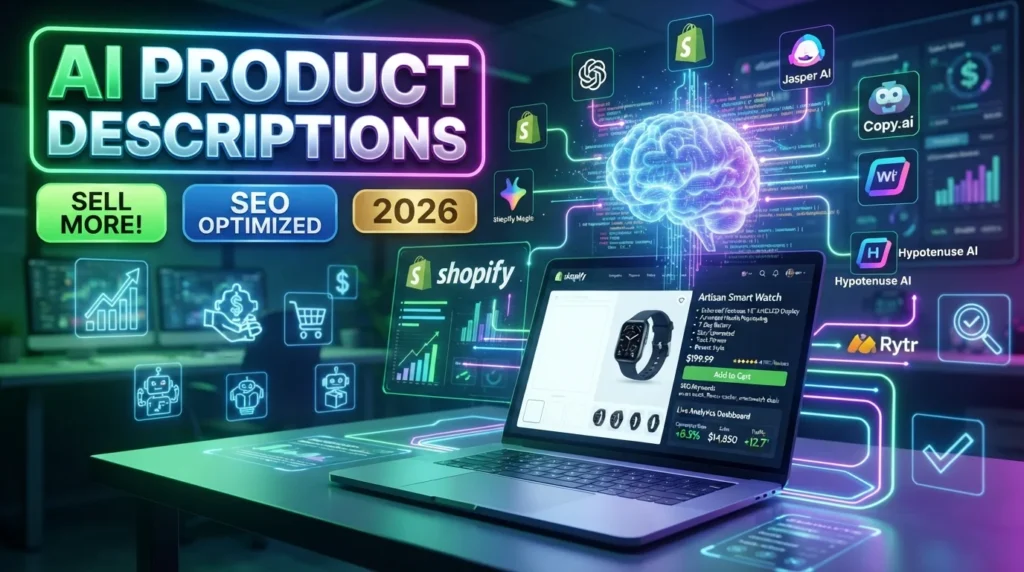
Selling products on Shopify is more competitive than ever. Thousands of online stores compete for customers’ attention, making compelling product descriptions essential for increasing conversions and improving search engine rankings.
Writing hundreds of unique product descriptions manually can take days or even weeks. Fortunately, Artificial Intelligence (AI) can speed up the process by generating persuasive, SEO-friendly, and customer-focused product descriptions within minutes.
AI can help create engaging copy, optimize keywords, improve readability, and highlight product benefits. However, the best results come from combining AI-generated content with human editing to ensure accuracy, originality, and your brand’s unique voice.
In this guide, you’ll learn how to create Shopify product descriptions with AI, discover the best AI writing tools, and explore practical strategies to increase sales in 2026.
For more AI software reviews, eCommerce tutorials, SEO guides, and business resources, visit:
Why Use AI for Shopify Product Descriptions?
AI simplifies product copywriting by generating content based on product information and customer intent.
AI can assist with:
- Product descriptions
- Product titles
- Feature lists
- Benefit-focused copy
- SEO optimization
- Product summaries
- Meta descriptions
- Product FAQs
- Call-to-actions
- Bulk content generation
Instead of spending hours writing similar descriptions, AI helps produce consistent, professional copy much faster.
Benefits of Using AI for Shopify Copywriting
Using AI offers several advantages.
Key Benefits
- Save hours of writing time
- Improve SEO optimization
- Create unique descriptions
- Maintain brand consistency
- Increase productivity
- Generate bulk product content
- Improve readability
- Highlight customer benefits
- Support higher conversion rates
- Scale your Shopify store efficiently
Step 1: Collect Complete Product Information
Before generating descriptions, gather detailed information including:
- Product name
- Category
- Features
- Materials
- Size
- Colors
- Specifications
- Target audience
- Benefits
- Unique selling points
The more accurate the information you provide, the more useful the AI-generated description is likely to be.
Step 2: Choose the Right AI Copywriting Tool
Several AI platforms are designed for eCommerce writing.
Popular options include:
- ChatGPT
- Jasper AI
- Copy.ai
- Shopify Magic
- Writesonic
- Hypotenuse AI
- Rytr
Each tool offers different strengths depending on your workflow and budget.
Step 3: Create a Detailed Prompt
Good prompts produce better descriptions.
Example prompt:
“Write a persuasive Shopify product description for a premium stainless steel insulated water bottle. Highlight durability, leak-proof design, temperature retention, eco-friendly materials, and include an SEO-friendly tone with a strong call-to-action.”
Specific prompts generally produce more relevant content.
Step 4: Focus on Customer Benefits
Instead of only listing features, explain how the product helps customers.
Example:
Instead of:
- 750ml capacity
Write:
- Large 750ml capacity keeps you hydrated throughout the day without frequent refills.
Benefit-focused writing often resonates more with shoppers.
Step 5: Optimize for SEO
AI can naturally include important keywords such as:
- Product type
- Brand name
- Category keywords
- Long-tail keywords
- Purchase intent keywords
Avoid keyword stuffing and prioritize readability.
Step 6: Improve Readability
Good product descriptions are easy to scan.
Use:
- Short paragraphs
- Bullet points
- Clear headings
- Simple language
- Action-oriented copy
Well-structured pages improve the shopping experience.
Step 7: Add a Strong Call-to-Action
Encourage customers to take action.
Examples include:
- Order today
- Shop now
- Add to cart
- Buy now
- Limited stock available
- Discover more
Calls-to-action should be relevant and aligned with your marketing approach.
Step 8: Review and Edit AI Content
Before publishing:
- Check product accuracy
- Verify specifications
- Remove repetitive phrases
- Match your brand voice
- Improve formatting
- Add unique selling points
- Proofread carefully
Human editing remains important for quality control.
Best AI Tools for Shopify Product Descriptions
ChatGPT
Best for:
- Product descriptions
- SEO copy
- Marketing content
Shopify Magic
Best for:
- Native Shopify integration
- Product writing
Jasper AI
Best for:
- eCommerce marketing
- Brand voice
Copy.ai
Best for:
- Short-form product copy
- Sales writing
Writesonic
Best for:
- SEO product descriptions
- Marketing copy
Hypotenuse AI
Best for:
- Bulk product descriptions
- Large online stores
Rytr
Best for:
- Affordable AI copywriting
- Small businesses
Comparison Table
| AI Tool | Best For | Free Plan | AI Features |
|---|---|---|---|
| ChatGPT | Product Writing | ✅ | ⭐⭐⭐⭐⭐ |
| Shopify Magic | Shopify Stores | Included with Shopify | ⭐⭐⭐⭐⭐ |
| Jasper AI | Marketing Copy | Trial | ⭐⭐⭐⭐⭐ |
| Copy.ai | Sales Copy | Limited | ⭐⭐⭐⭐ |
| Writesonic | SEO Copywriting | Limited | ⭐⭐⭐⭐ |
| Hypotenuse AI | Bulk Product Content | Trial | ⭐⭐⭐⭐⭐ |
| Rytr | Budget Copywriting | ✅ | ⭐⭐⭐⭐ |
Best Practices for AI Product Descriptions
- Write for customers first
- Include SEO keywords naturally
- Highlight benefits over features
- Keep descriptions unique
- Maintain consistent branding
- Add persuasive calls-to-action
- Review AI-generated content
- Update descriptions regularly
Common Mistakes to Avoid
Avoid these common pitfalls:
- Publishing AI-generated copy without editing
- Copying manufacturer descriptions
- Keyword stuffing
- Using generic marketing language
- Ignoring customer pain points
- Writing overly long descriptions
- Forgetting mobile readability
Benefits of AI for Shopify Stores
AI helps store owners:
- Save time
- Improve SEO
- Increase productivity
- Create consistent content
- Scale product catalogs
- Improve conversion-focused writing
- Reduce manual work
- Support business growth
Final Verdict
AI has transformed Shopify copywriting by making it easier to create optimized, engaging, and customer-focused product descriptions. Tools such as ChatGPT, Shopify Magic, Jasper AI, Copy.ai, Writesonic, Hypotenuse AI, and Rytr can dramatically reduce writing time while improving consistency across your online store.
However, AI should be viewed as a writing assistant rather than a complete replacement for human creativity. The highest-performing product pages combine AI-generated drafts with careful editing, accurate product information, and a strong understanding of customer needs.
Frequently Asked Questions
Can AI write Shopify product descriptions?
Yes. AI can generate product descriptions, titles, feature lists, SEO copy, and calls-to-action. Human review is recommended to ensure accuracy, originality, and alignment with your brand.
Which AI tool is best for Shopify product descriptions?
The best choice depends on your needs. ChatGPT is excellent for flexible writing, Shopify Magic integrates directly with Shopify, Jasper AI supports branded marketing copy, and Hypotenuse AI is designed for bulk product content.
Can AI improve Shopify SEO?
AI can help optimize product pages by naturally incorporating relevant keywords, improving readability, and generating structured content. SEO performance also depends on factors such as site structure, backlinks, page speed, and overall content quality.
Is AI suitable for large Shopify stores?
Yes. AI tools can help businesses with large product catalogs generate and update descriptions more efficiently while maintaining consistency across listings.
Internal Link
Explore more AI tools, eCommerce tutorials, SEO guides, and business automation resources at: