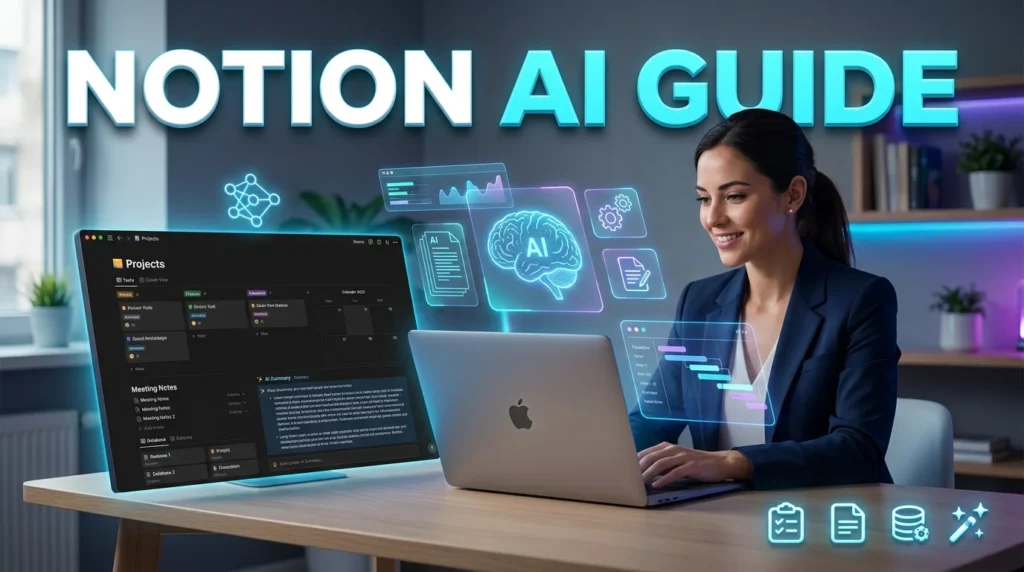
Artificial intelligence is changing the way people organize information, manage projects, and create content. One of the most popular productivity platforms embracing AI is Notion. By combining powerful workspace features with AI capabilities, Notion helps users write, summarize, brainstorm, organize, and automate everyday tasks.
Whether you’re a student, freelancer, business owner, content creator, or project manager, learning how to use AI with Notion can significantly improve your workflow and save valuable time.
This guide explains how Notion AI works, its key features, practical use cases, and best practices for getting the most out of it.
What Is Notion AI?
Notion AI is an integrated artificial intelligence assistant built into the Notion workspace. It helps users generate text, summarize documents, answer questions, organize information, translate content, improve writing, and automate repetitive tasks—all without leaving the workspace.
Instead of switching between multiple AI tools, you can work directly inside your notes, databases, and project pages.
Why Use AI with Notion?
Notion AI offers several productivity benefits, including:
- Faster content creation
- Automatic note summarization
- Better task organization
- Improved writing quality
- Brainstorming assistance
- Project planning
- Knowledge management
- Reduced manual work
Whether you’re writing documentation or organizing research, AI helps streamline the process.
Getting Started with Notion AI
Using AI in Notion is simple.
1. Create or Open a Workspace
Start by opening an existing page or creating a new one in your Notion workspace.
2. Access AI Features
Within a page, use the built-in AI options to:
- Generate content
- Edit text
- Summarize notes
- Brainstorm ideas
- Translate content
- Improve grammar
The AI assistant works directly within your document, making collaboration seamless.
Use AI for Writing
One of the most popular uses of Notion AI is content generation.
It can help create:
- Blog outlines
- Articles
- Emails
- Reports
- Meeting agendas
- Product descriptions
- Marketing copy
- Social media posts
Provide a clear prompt, and AI will generate a draft that you can refine further.
Summarize Long Documents
Reading lengthy notes or reports can be time-consuming.
Notion AI can quickly summarize:
- Meeting notes
- Research papers
- Project documentation
- Client feedback
- Study materials
This allows you to focus on key insights rather than reviewing every detail.
Brainstorm Ideas
Creative blocks happen to everyone.
Notion AI can generate ideas for:
- Business names
- Marketing campaigns
- Product features
- Blog topics
- YouTube videos
- Research questions
- Event planning
Using AI as a brainstorming partner can speed up the creative process.
Organize Tasks with AI
Project management becomes easier when AI assists with organization.
Examples include:
- Creating task lists
- Prioritizing work
- Breaking projects into milestones
- Generating checklists
- Assigning action items
- Summarizing project updates
Combined with Notion databases, these features help teams stay organized.
Improve Your Writing
Notion AI can refine existing text by:
- Correcting grammar
- Improving clarity
- Rewriting paragraphs
- Changing tone
- Simplifying complex language
- Expanding short ideas
This is useful for professional documents, reports, and client communications.
Translate Content
If you work with international teams or audiences, Notion AI can translate text into multiple languages, making collaboration more efficient and reducing the need for external translation tools.
Use AI for Knowledge Management
Many organizations use Notion as a centralized knowledge base.
AI makes it easier to:
- Search documents
- Summarize policies
- Retrieve information
- Explain technical content
- Organize research
- Build internal documentation
This reduces time spent searching across multiple files.
AI for Meeting Notes
Instead of manually organizing meeting notes, AI can:
- Summarize discussions
- Identify action items
- Highlight decisions
- Create follow-up tasks
- Generate meeting recaps
This improves communication and accountability within teams.
Best Practices for Using AI with Notion
To maximize results:
- Write clear prompts.
- Review AI-generated content before publishing.
- Organize pages with consistent structures.
- Keep databases updated.
- Use AI to assist—not replace—critical thinking.
- Combine AI with templates for recurring workflows.
- Protect sensitive information when using AI features.
These practices improve both efficiency and content quality.
Common Mistakes to Avoid
Avoid these common issues:
- Using vague prompts
- Relying entirely on AI without review
- Overloading pages with unnecessary content
- Ignoring fact-checking
- Poor workspace organization
- Forgetting to update outdated information
AI performs best when guided with clear context and human oversight.
Real-World Applications
Students
- Organize lecture notes
- Summarize textbooks
- Create study guides
- Generate revision questions
Content Creators
- Draft blog posts
- Plan content calendars
- Brainstorm video ideas
- Write social media captions
Businesses
- Create documentation
- Manage projects
- Summarize meetings
- Build knowledge bases
Freelancers
- Draft proposals
- Manage clients
- Organize research
- Track deadlines
Teams
- Collaborate on documents
- Manage workflows
- Assign tasks
- Share project updates
The Future of AI in Notion
AI-powered workspaces continue to evolve. Future developments are expected to include:
- More advanced AI agents
- Smarter workflow automation
- Better contextual search
- Enhanced collaboration features
- Personalized productivity suggestions
- Deeper integrations with third-party apps
As AI capabilities expand, Notion is likely to become an even more comprehensive digital workspace.
Conclusion
Notion AI combines note-taking, project management, and artificial intelligence into a single platform that helps individuals and teams work more efficiently. From writing and summarizing to brainstorming and organizing, AI can simplify daily tasks while improving productivity.
Although AI can automate many routine activities, reviewing outputs, verifying information, and applying human judgment remain essential for producing reliable results.
For more AI tutorials, productivity tips, and automation guides, visit https://aitrendshub.com.