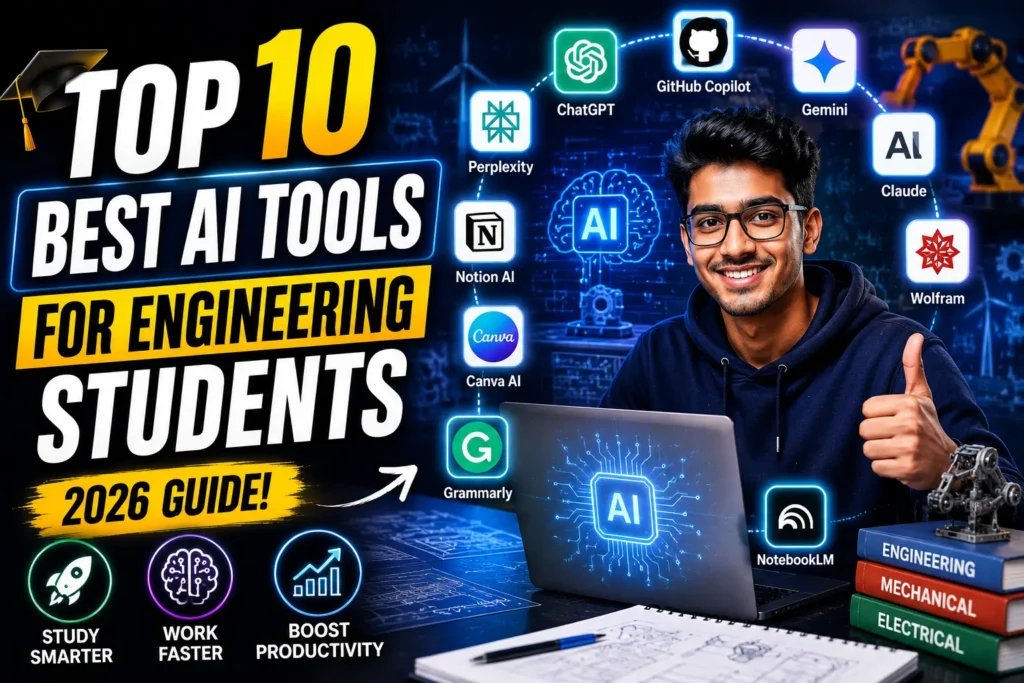
Artificial Intelligence is transforming engineering education by helping students learn faster, write better code, solve complex problems, and manage projects more efficiently. Whether you’re studying computer science, software engineering, electrical engineering, civil engineering, or mechanical engineering, AI tools can save hours of work and improve your academic performance.
In this guide, we’ll explore the top 10 best AI tools for engineering students, their key features, and how they can help you succeed in 2026.
Why Engineering Students Should Use AI Tools
Engineering programs involve coding, mathematics, research, simulations, technical writing, and project collaboration. AI tools can automate repetitive tasks while helping students understand difficult concepts more effectively.
Benefits include:
- Faster coding
- Better research
- Improved technical writing
- Homework assistance
- Debugging support
- Design inspiration
- Project organization
- Time management
- Increased productivity
- Enhanced learning
Remember, AI should support your learning—not replace critical thinking or violate your institution’s academic integrity policies.
1. ChatGPT
Best For: General learning, coding, brainstorming, and technical explanations
ChatGPT is one of the most versatile AI assistants available. Engineering students can use it to:
- Explain engineering concepts
- Write and debug code
- Solve programming problems
- Generate project ideas
- Summarize research papers
- Prepare for exams
- Draft reports
- Learn new technologies
Pros
- Beginner-friendly
- Supports multiple programming languages
- Excellent explanations
- Fast responses
Best For: Every engineering student
2. GitHub Copilot
Best For: Programming assistance
GitHub Copilot helps students by:
- Auto-completing code
- Suggesting functions
- Detecting common errors
- Writing boilerplate code
- Explaining code snippets
Perfect for software, computer, and AI engineering students.
3. Google Gemini
Best For: Research and productivity
Gemini helps students:
- Research technical topics
- Summarize documents
- Generate study notes
- Brainstorm project ideas
- Answer engineering questions
Useful for multidisciplinary engineering coursework.
4. Claude
Best For: Long technical documents
Claude excels at:
- Reading lengthy PDFs
- Explaining research papers
- Improving technical reports
- Summarizing complex documentation
- Reviewing project proposals
Ideal for final-year projects and literature reviews.
5. Perplexity AI
Best For: Academic research
Perplexity AI provides:
- AI-powered search
- Source-backed answers
- Research summaries
- Citation assistance
- Technical explanations
Excellent for finding reliable information quickly.
6. Wolfram
Best For: Mathematics and engineering calculations
Wolfram is particularly useful for:
- Calculus
- Differential equations
- Linear algebra
- Statistics
- Physics
- Engineering mathematics
- Graph plotting
A valuable companion for solving technical problems.
7. Notion AI
Best For: Productivity and organization
Engineering students can use Notion AI to:
- Organize lecture notes
- Create study plans
- Track assignments
- Manage group projects
- Summarize meeting notes
- Build knowledge bases
Great for staying organized throughout the semester.
8. Canva AI
Best For: Presentations and visual design
Canva AI helps students create:
- Project presentations
- Posters
- Infographics
- Flowcharts
- Technical diagrams
- Portfolio designs
Useful for presenting engineering projects professionally.
9. Grammarly
Best For: Technical writing
Grammarly improves:
- Grammar
- Clarity
- Tone
- Professional writing
- Reports
- Research papers
- Emails
A polished report can make a strong impression during project evaluations.
10. NotebookLM
Best For: Studying personal course materials
NotebookLM allows students to upload their own notes and documents, then ask questions based on that content.
It can help with:
- Reviewing lecture notes
- Summarizing textbooks
- Preparing for exams
- Understanding project documentation
- Connecting ideas across multiple sources
This makes revision more focused and interactive.
How to Choose the Right AI Tool
Consider these factors before selecting an AI tool:
- Your engineering discipline
- Budget
- Ease of use
- Privacy requirements
- Collaboration features
- Offline vs. cloud access
- Integration with existing tools
- Accuracy and reliability
Using a combination of tools often provides the best results.
Tips for Using AI Responsibly
To get the most value from AI:
- Verify technical information
- Understand generated code before using it
- Cite sources when required
- Avoid submitting AI-generated work as your own if prohibited
- Use AI to learn concepts rather than simply obtaining answers
Responsible use strengthens your skills and supports academic integrity.
Internal Learning Resources
If you’re interested in learning more about AI, productivity, and automation, explore additional tutorials and guides on https://aitrendshub.com. You’ll find practical resources covering AI tools, SEO, content creation, and emerging technologies.
Frequently Asked Questions
Which AI tool is best for engineering students?
There is no single best option. ChatGPT is excellent for learning and coding, GitHub Copilot supports programming, Perplexity AI helps with research, Wolfram is ideal for mathematics, and NotebookLM is great for studying personal materials.
Are AI tools free?
Many AI tools offer free plans with optional premium features. The available functionality varies by platform.
Can AI help with engineering projects?
Yes. AI can assist with brainstorming, coding, documentation, research, calculations, presentations, and project planning. However, students should always review and validate AI-generated work.
Is it okay to use AI for homework?
This depends on your institution’s policies. AI is best used as a learning assistant rather than a way to bypass assignments. Always follow your university’s academic integrity guidelines.
Final Thoughts
AI has become an essential companion for engineering students, helping with everything from programming and research to technical writing and project management. By choosing the right combination of AI tools, you can improve productivity, deepen your understanding of engineering concepts, and better prepare for future careers.
Remember that AI is most effective when combined with your own knowledge, critical thinking, and hands-on practice. Use it to enhance your learning—not replace it.
For more AI tutorials, software reviews, and productivity tips, visit https://aitrendshub.com