
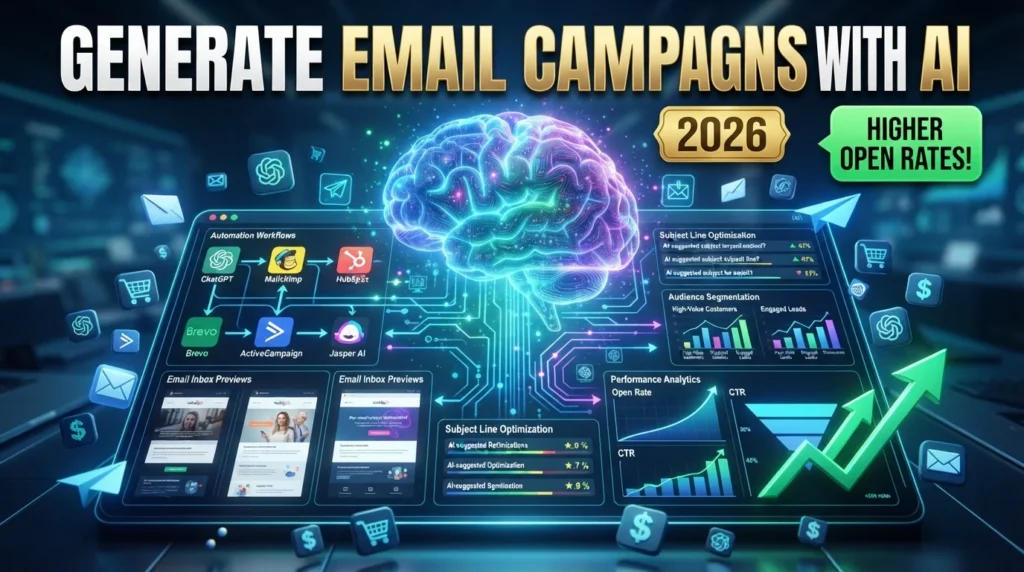
AI email marketing uses artificial intelligence to automate and improve different aspects of email campaigns, including:
- Subject line generation
- Email copywriting
- Audience segmentation
- Personalization
- Product recommendations
- Send-time optimization
- A/B testing
- Campaign analytics
- Workflow automation
- Performance optimization
AI helps marketers create more relevant emails while reducing repetitive manual work.
Why Use AI for Email Marketing?
AI-powered email marketing offers several benefits:
- Faster campaign creation
- Personalized messaging
- Higher open rates
- Improved click-through rates (CTR)
- Better customer segmentation
- Automated workflows
- Smarter product recommendations
- Increased conversions
- Time savings
- Scalable marketing campaigns
AI allows businesses to communicate with subscribers more effectively while improving efficiency.
Step 1: Define Your Campaign Goal
Before generating emails, identify your objective.
Common goals include:
- Welcome new subscribers
- Promote products
- Increase sales
- Recover abandoned carts
- Generate leads
- Re-engage inactive subscribers
- Share newsletters
- Announce new launches
A clear goal helps AI generate more relevant content.
Step 2: Understand Your Audience
AI performs best when it has audience context.
Segment subscribers by:
- Demographics
- Purchase history
- Interests
- Website behavior
- Engagement level
- Location
- Customer lifecycle stage
Audience segmentation improves personalization and campaign performance.
Step 3: Choose the Best AI Email Marketing Tool
Several AI tools can assist with email marketing.
1. ChatGPT
Best for:
- Email copywriting
- Subject lines
- Welcome emails
- Promotional campaigns
- Newsletter ideas
2. Mailchimp AI
Best for:
- Email automation
- Audience segmentation
- Campaign optimization
3. HubSpot AI
Best for:
- CRM-based email marketing
- Lead nurturing
- Personalized campaigns
4. Brevo (formerly Sendinblue)
Best for:
- Marketing automation
- Transactional emails
- AI-powered workflows
5. ActiveCampaign AI
Best for:
- Customer journeys
- Behavior-based automation
- Personalized messaging
6. Klaviyo AI
Best for:
- E-commerce email marketing
- Product recommendations
- Customer retention
7. Jasper AI
Best for:
- Marketing copy
- Promotional emails
- Brand voice consistency
Step 4: Generate Engaging Subject Lines
The subject line determines whether your email gets opened.
AI can generate variations that use:
- Curiosity
- Personalization
- Numbers
- Urgency
- Questions
- Benefits
Examples:
- Save 30% Today – Limited Time
- Your AI Productivity Guide Is Ready
- Discover the Best AI Tools for Business
- Don’t Miss This Exclusive Offer
Test different subject lines to improve open rates.
Step 5: Write Personalized Email Copy
Effective emails should:
- Address subscriber pain points
- Highlight benefits
- Keep paragraphs short
- Use conversational language
- Match your brand voice
- End with a clear call to action
AI can personalize content using subscriber data, but always review outputs for accuracy and privacy compliance.
Step 6: Add a Strong Call to Action
Examples include:
- Shop Now
- Get Started
- Download Free
- Book a Demo
- Learn More
- Claim Your Discount
- Start Your Free Trial
A clear CTA encourages readers to take the next step.
Step 7: Automate Email Workflows
AI helps automate common email sequences, including:
Welcome Series
Introduce new subscribers to your brand.
Abandoned Cart Emails
Encourage customers to complete purchases.
Product Recommendations
Suggest relevant products based on browsing or purchase history.
Re-engagement Campaigns
Reconnect with inactive subscribers.
Post-Purchase Follow-ups
Thank customers and encourage repeat business.
Automation saves time while improving consistency.
Step 8: Optimize Send Times
AI analyzes engagement patterns to recommend the best time to send emails.
Factors may include:
- Time zones
- Historical open rates
- Subscriber behavior
- Device usage
- Day of the week
Optimal timing can improve campaign performance.
Step 9: A/B Test Your Campaigns
Use AI to generate multiple versions of:
- Subject lines
- Headlines
- Email body copy
- Images
- CTAs
- Offers
Testing helps identify which variations resonate best with your audience.
Step 10: Monitor Campaign Performance
Track important metrics such as:
- Open rate
- Click-through rate (CTR)
- Conversion rate
- Bounce rate
- Unsubscribe rate
- Revenue per email
- Spam complaints
AI analytics can help identify trends and opportunities for improvement.
Best AI Tools for Email Marketing
ChatGPT
Best for:
- Email writing
- Subject lines
- Brainstorming
Mailchimp AI
Best for:
- Campaign automation
- Audience segmentation
HubSpot AI
Best for:
- CRM integration
- Lead nurturing
Brevo
Best for:
- Marketing automation
- Transactional emails
ActiveCampaign AI
Best for:
- Personalized workflows
- Customer journeys
Klaviyo AI
Best for:
- E-commerce email campaigns
- Product recommendations
Jasper AI
Best for:
- Marketing copy
- Promotional emails
Comparison Table
| AI Tool | Best For | Free Plan | AI Features |
|---|---|---|---|
| ChatGPT | Email Copywriting | ✅ | ⭐⭐⭐⭐⭐ |
| Mailchimp AI | Email Automation | ✅ | ⭐⭐⭐⭐⭐ |
| HubSpot AI | CRM Email Marketing | Limited | ⭐⭐⭐⭐⭐ |
| Brevo | Marketing Automation | ✅ | ⭐⭐⭐⭐ |
| ActiveCampaign AI | Customer Journeys | Trial | ⭐⭐⭐⭐ |
| Klaviyo AI | E-commerce Emails | Limited | ⭐⭐⭐⭐ |
| Jasper AI | Marketing Copy | Trial | ⭐⭐⭐⭐ |
Common Mistakes to Avoid
Avoid these email marketing mistakes:
- Generic subject lines
- Overusing promotional language
- Sending too many emails
- Ignoring audience segmentation
- Weak CTAs
- Skipping A/B testing
- Not reviewing AI-generated content
- Failing to monitor analytics
Best Practices
To improve AI-generated email campaigns:
- Personalize content where appropriate
- Keep emails concise
- Use benefit-focused messaging
- Segment your audience
- Test multiple subject lines
- Optimize send times
- Review AI outputs for accuracy
- Maintain a consistent brand voice
Benefits of AI Email Marketing
AI helps businesses:
- Save time
- Increase open rates
- Improve click-through rates
- Personalize campaigns
- Automate workflows
- Scale email marketing
- Generate creative ideas
- Make data-driven decisions
Final Verdict
AI has transformed email marketing by simplifying copywriting, automation, and campaign optimization. Tools such as ChatGPT, Mailchimp AI, HubSpot AI, Brevo, ActiveCampaign AI, Klaviyo AI, and Jasper AI help marketers create more engaging email campaigns while reducing manual effort.
For the best results, combine AI-generated content with human creativity and strategic oversight. Review email copy for accuracy, maintain a consistent brand voice, respect privacy regulations, and continue testing to improve campaign performance over time.
Frequently Asked Questions
Can AI create email marketing campaigns?
Yes. AI tools can generate subject lines, email copy, automation workflows, and personalization suggestions. Human review is recommended before sending campaigns.
Which AI tool is best for email marketing?
ChatGPT is excellent for writing content, while Mailchimp AI, HubSpot AI, ActiveCampaign AI, and Klaviyo AI offer strong automation and customer segmentation features.
Can AI improve email open rates?
AI can help generate more compelling subject lines and recommend optimal send times, which may improve open rates. Results also depend on audience quality, relevance, and overall email strategy.
Is AI-generated email content safe to use?
Generally, yes. However, you should review AI-generated content for accuracy, align it with your brand voice, and ensure compliance with applicable privacy and email marketing regulations.
Internal Link
Discover more AI marketing tools, SEO guides, and productivity resources at:


